

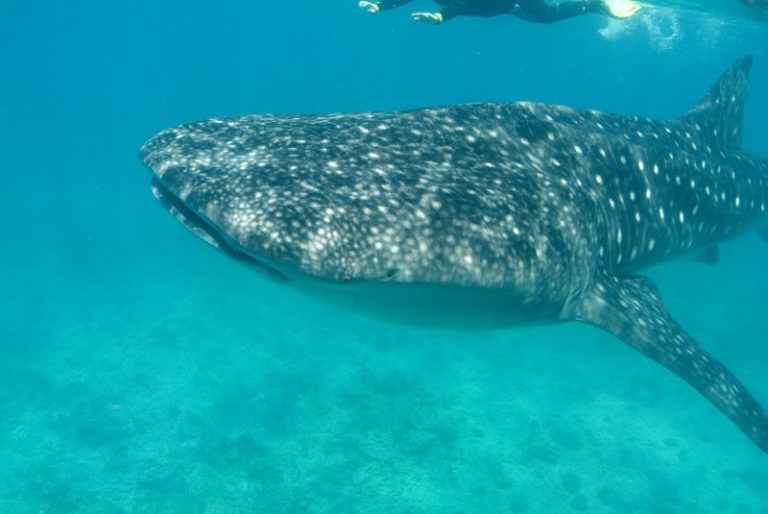
The whale shark belongs to a group called Chondrichthyes, which includes other sea life like sharks, skates, and rays. A common question asked is “How many bones does a whale shark have?” and the answer is none! The criteria of Chondrichthyes is that they have a skeleton made up of cartilage, rather than bone. They are gentle giants and as filter feeders, they eat through filters in their mouths. Only 3 species of sharks are filter feeders including whale sharks, basking sharks, and megamouth sharks. A whale shark can have up to 3000 teeth at once and between 300 and 350 rows of teeth.
Whale sharks are considered to be harmless to humans despite their enormous size. They can reach up to 12 meters or 40 feet in length
but feed on some of the smallest organisms in the ocean called plankton.
Their appearance is incredible not only because they are so large, but also because they have a unique pattern of white spots that cover its body. They have a naturally calm demeanor, which is popular with eco-tourists that want to snorkel beside them. The pattern of spots around their gill area is unique to each individual which allows for easier identification. They have enormous mouths that can reach a width of 1 meter (more than 3 feet).
The best way to tell the difference between a male and female whale shark is that the males have two claspers near their pelvic fin.
As a species, they do not become sexually mature until they are 30 years. The females can have up to 300 shark pups at one time.
The greatest threat to sharks is the loss of prey largely due to climate change, habitat disturbance, and ocean pollution. They do not have natural predators, other than humans.
Whale sharks are found in the waters of more than 100 countries, most broadly found in the latitudes of 30°N and 35°S in warm and tropical temperate seas. They prefer surface seawater temperatures between 21 – 25°C (69 – 77°F) in both oceanic and coastal waters. They often congregate in areas they can feed, which is sometimes makes for a very long migration.
Common places you can visit this shark species are Mexico, Belize, Malaysia, Thailand, the Philippines, Japan, Australia, the Galapagos, South Africa, Mozambique, Honduras, Seychelles, and India.
This map outlines the regions you can find them in the wild:

Check out these tours that offer the opportunity to see whale sharks responsibly:
RED Travel Mexico, an award-winning social enterprise that leads to responsible learning expeditions around Whale S
harks in Mexico. To learn about their incredible ‘Whale Shark Researcher for a Day’ itinerary, click here.


